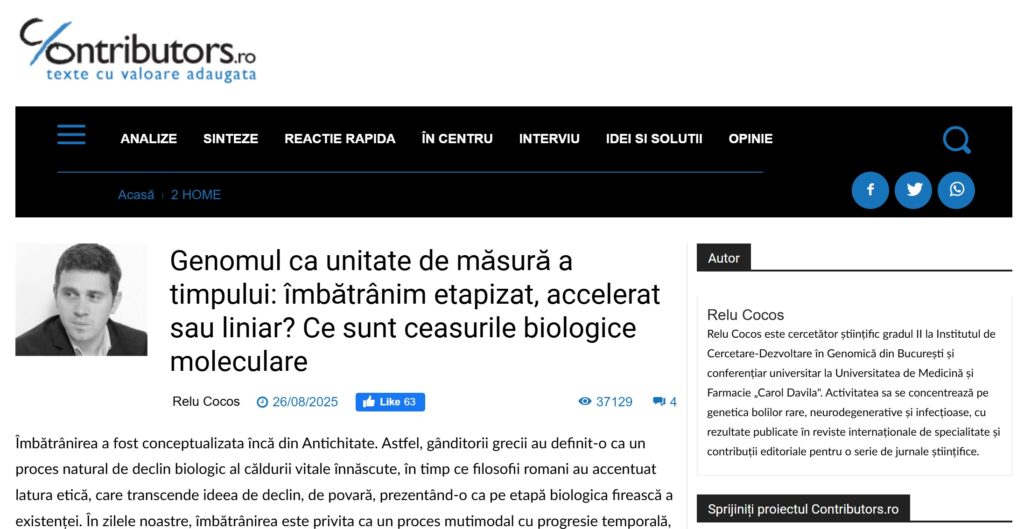
Dr. Relu Cocoș, CSII, coordinator of genomic sequencing activities at the Institute for Research and Development in Genomics in Bucharest (ICDG), has published on Contributors.ro a highly topical article accessible to a wide audience, about the hidden mechanisms of biological clocks, which open a new perspective on aging.
The ageing process does not follow a fixed and immutable algorithm inscribed in each individual's genome, but is a holistic phenomenon in which each person can, to a certain extent, be the architect of their own biological evolution. Ageing is not just the passage of years, but a complex process marked by genetic, epigenetic and proteomic changes. If chronological age is just a number, biological age tells the truth about how much the body has 'worn out'.
Researchers have developed methods based on machine learning algorithms to tap into these 'biological clocks', which can predict not only the body's actual age, but also the risk of disease or even life expectancy. Studies show that ageing is not linear, but has accelerated stages around the ages of 40 and 60, which explains why physical and cognitive changes are felt suddenly.
Extensive research has unequivocally demonstrated that lifestyle and environment have a significant impact on biological age, with almost ten times more influence on longevity than genetics.
Full article here: Contributors.ro
More on the work of the CGDI at: https://genomica.gov.ro/
#ICDG #GRDI #Genomics #Genomics #Genomics #Genomic #Genomics #Genomic #Genetic #Genetic #Genetic #Genetic #Genetic #Genetic
Follow the link below to find out more from the interview: